How AI Is Reshaping Supply Chain Management—and Your Job.
A supplier slips a delivery date, a promotion outruns the forecast, and your team spends the morning reconciling spreadsheets before deciding what to do. Meanwhile, someone asks whether artificial intelligence can fix the supply chain by Friday.
AI in supply chain management can help teams predict problems, compare responses, interpret documents, and coordinate physical work. The bigger change is how managers organize decisions: what the system recommends, what it may execute, and when people intervene. To evolve, learn data quality, analytical testing, workflow design, and AI oversight alongside your operational expertise.
Understand the different jobs AI can do
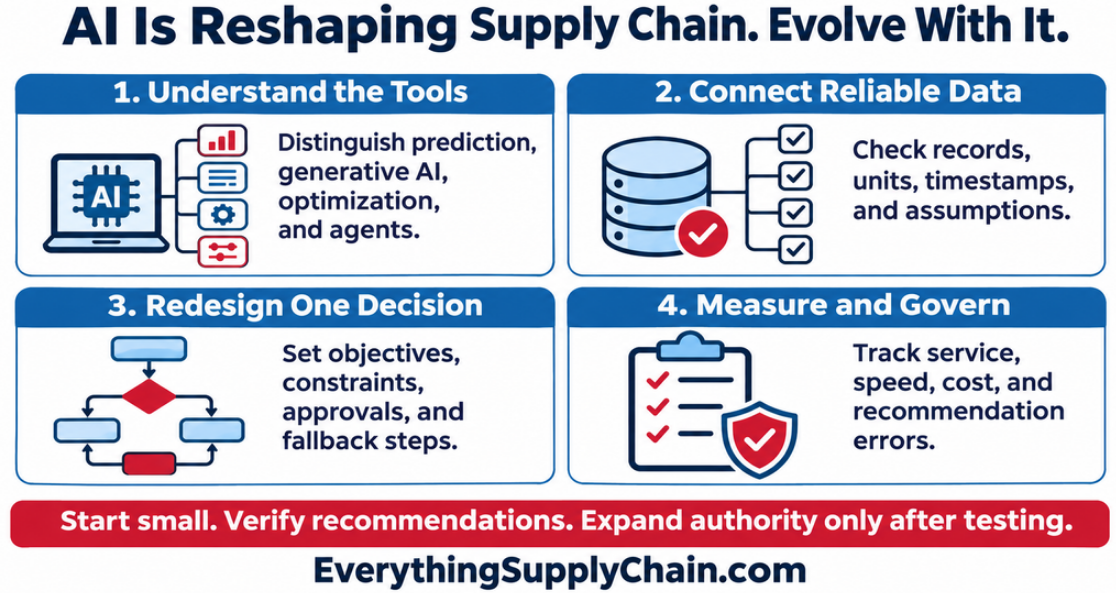
AI is a broad family of technologies, not a single digital employee. Machine learning finds patterns for tasks such as demand forecasting; computer vision interprets images; generative AI produces content such as supplier summaries and draft explanations. Optimization selects actions within objectives and constraints, and it can work alongside AI without itself being machine learning.
Agentic systems connect models with tools to carry out multistep tasks within assigned permissions. A supplier-risk assistant might retrieve order records, summarize a delay, and prepare an escalation; whether it can send that escalation depends on its integration and authority.
The site’s machine learning and supply chain automation resource provides related background. For a more structured introduction to these distinctions, explore AI fundamentals for supply chain leaders on SupplyChainToday.com.
Where AI in supply chain management is already working
Unilever describes its Forecast Engine Utility as combining machine learning and data science to generate a weekly, 104-week forecast across more than five million product–customer combinations in 40 operating markets. Its account of an AI-powered supply chain also describes connecting retailer forecasts and sales information back to material sourcing. The managerial lesson is to connect forecasting with replenishment and capacity decisions, rather than treating a forecast as a finished answer. Unilever
Walmart’s Route Optimization announcement describes technology used to plan routes, improve trailer packing, and reduce unnecessary mileage. This illustrates how decisions interact: a cheap route is not useful if the load cannot fit or the delivery misses its receiving window. Managers need to define operating constraints before judging a recommendation. corporate.walmart.com
Amazon’s DeepFleet announcement describes an AI model designed to coordinate warehouse robots and reduce congestion. The opportunity extends beyond making one machine faster to improving how a fleet works together. That requires managers to understand bottlenecks and workflow, not merely count robots.
These are company-reported applications, not promises of equivalent results elsewhere. Their common thread is a specific operating decision supported by connected data, technology, and process knowledge.
Move from producing reports to managing exceptions
Consider a planner who spends hours assembling a shortage list. A connected system could identify threatened orders, retrieve relevant transactions, and rank candidate responses, leaving the planner more time to investigate the cases that matter.
The manager must define what “matters” means. Protecting a critical customer, avoiding a production shutdown, and minimizing transport cost can produce different priorities. A faster recommendation is valuable only when it serves the right objective.
Procurement follows the same logic: a tool can compare quotes or extract contract clauses, but somebody must verify commercial terms and approve commitments. In manufacturing, image analysis or failure prediction must connect to a workable inspection or maintenance response. Your role increasingly includes designing that response and checking whether it works.
Build five skills that make operational experience more valuable
You do not need to start by becoming a model developer. Start by learning enough to specify a useful problem, challenge the answer, and work effectively with technical colleagues.
- Data literacy: Trace item identifiers, units, dates, and missing transactions to their sources. Distinguish customer demand from shipments constrained by stockouts.
- Analytical judgment: Compare performance with a simple baseline and test on later periods the model did not see during development.
- Workflow design: Identify the trigger, required evidence, decision owner, approval point, and fallback when the tool fails.
- AI instruction and verification: Specify context, constraints, and output format; check the resulting sources and calculations.
- Change leadership: Involve users, investigate overrides, and train people to recognize both useful recommendations and misleading ones.
MIT’s discussion of supply chain skills in the AI era reinforces the importance of business context, analytical foundations, and supply chain knowledge. For practical data preparation, SupplyChainToday.com’s supply chain data foundations resource offers a useful learning path. Center for Transportation and Logistics
Worked example: turn a delay alert into a decision
Imagine a hypothetical distributor evaluating an AI-assisted shortage workflow. Assume usable stock is 100 units, demand is exactly 20 units daily, no other supply is available, and a 100-unit replenishment now arrives at the start of day eight instead of day five.
The existing stock covers 100 ÷ 20 = five days. Demand on days six and seven creates a 2 × 20 = 40-unit gap before the shipment arrives. An assistant connected to reliable records could identify the gap and present alternatives; a deterministic calculation should verify the arithmetic.
Assume a sister warehouse can release 40 units without threatening its own commitments and deliver them before day six. At an incremental transfer cost of $3 per unit, that option costs $120; an emergency supplier quotes an all-in incremental premium of $8 per unit, or $320. The transfer is $200 cheaper under these assumptions, before any omitted handling or service costs.
The manager still checks reservations, transport feasibility, and product compatibility. The site’s inventory optimization overview provides context for those inventory decisions. The improvement being tested is a faster, better-supported response—not an assumption that every AI alert is correct.
Set boundaries before granting execution authority
Generative AI can provide a confident explanation that is false. The National Institute of Standards and Technology’s generative AI risk profile identifies this risk, commonly called hallucination, and recommends evaluating capabilities and verifying sources. nvlpubs.nist.gov
Require recommendations to show the records, timestamps, assumptions, and constraints used. Keep approved alternatives available, log actions, and define who can stop an automated workflow. Supplier documents and messages should be treated as evidence, not instructions that can change the system’s authority.
Use approved environments for confidential commercial information. Begin with recommendations reviewed by people, then consider limited execution only after testing exceptions, permissions, and rollback. Neither better prompting nor cleaner data alone establishes that a process is safe to automate.
Start with one decision and four measures
Choose a recurring problem with accessible data and a clear owner, such as delayed-order triage. Map the current process, record a baseline, and run the AI workflow alongside it before allowing operational changes. Thirty days can establish feasibility; seasonal and infrequent events need longer evaluation.
Use four key performance indicators (KPIs) together: decision lead time from alert to approved response; immediate unit fill rate, calculated as units supplied immediately divided by units requested; incremental intervention cost, including transfers and expediting; and material recommendation error rate, using documented rules for what counts as an error. Review all four against comparable conditions, since faster decisions can still be wrong or expensive.
Bring one planner, one data specialist, and one process owner into the pilot. Agree on which decisions require approval, rehearse a failed-data scenario, and review rejected recommendations weekly. Your next learning assignment is to explain one decision well enough that a system can assist—and your team can tell when it should not.
AI Resources:
- Best AI Quotes of All Time: Wisdom from Innovators, CEOs, and Visionaries.
- Elon Musk Says AI Changes Everything in 10 Years. Are We Ready?
- Regular AI vs. Superintelligence: Understanding Where AI Risk Begins.
- Revolutionizing Wendy’s Supply Chain With Palantir.
- The Executive’s Guide to Applying AI to Business Strategy.
- World Humanoid Robot Games in China: What the “Robot Olympics” Tell Us About the Future of Work.
- 12 Possible Futures for AI: Decisions We Make Today Could Shape Everything.