How to Reduce Excess Inventory Without Increasing Stockouts
Your warehouse is full, finance wants inventory down, and customer service is still chasing missing parts. An across-the-board cut sounds decisive until the wrong item disappears from the shelf.
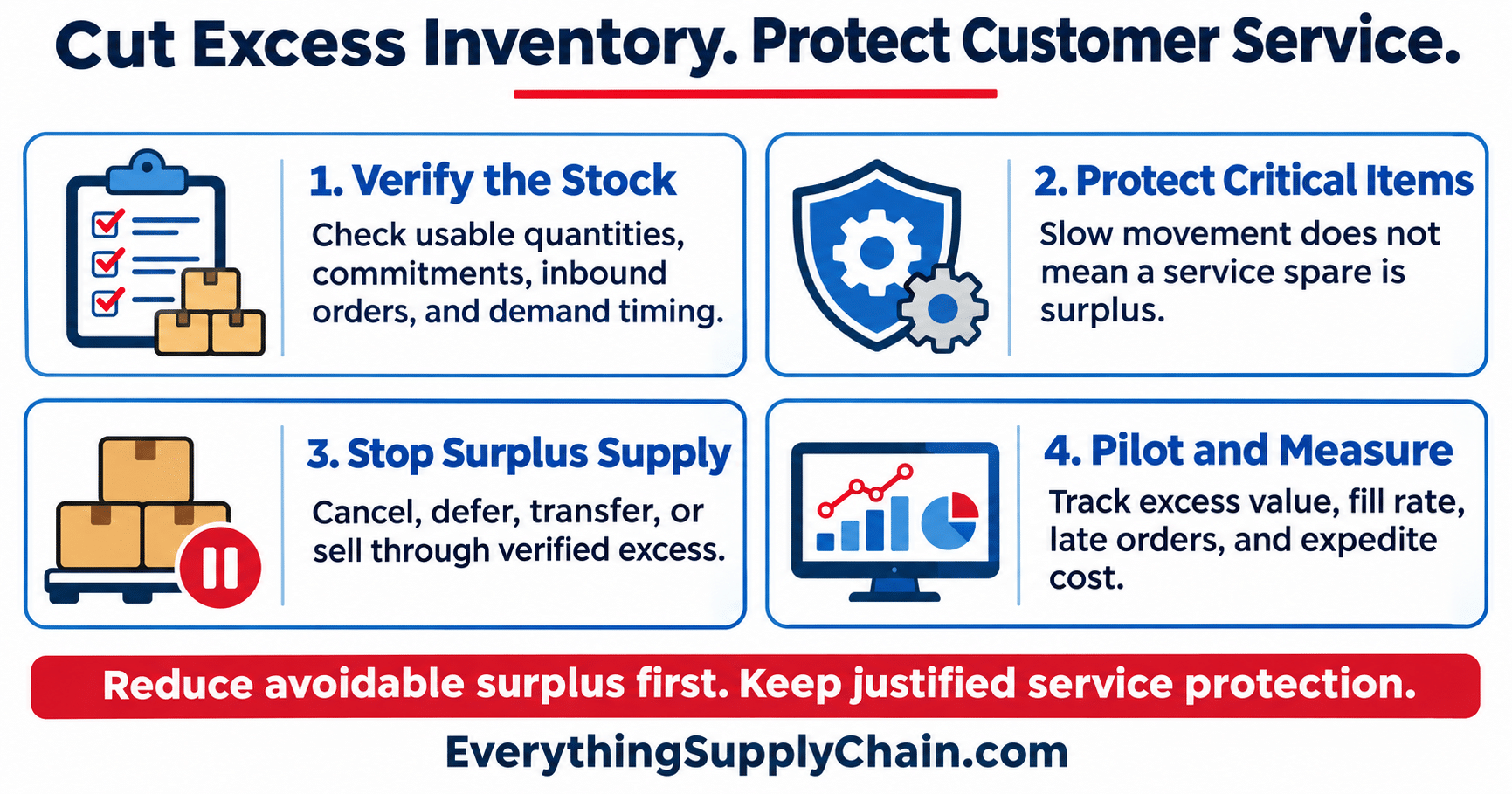
To reduce excess inventory without increasing stockouts, start with avoidable replenishment and stock above a justified requirement. Protect items whose absence would stop operations or break a service commitment, then test reductions against demand and replenishment risk. The goal is less money in the wrong stock, with the right stock available when needed.
Define excess before choosing what to cut
Excess inventory is stock beyond a defensible requirement, not simply stock that has aged. A seasonal product awaiting its selling window and an emergency spare may both sit untouched without being unnecessary.
Review each stock keeping unit (SKU) at each location. Reconcile usable on-hand quantities, reservations, backorders, incoming orders, shelf life, and expected demand without counting commitments twice. Project balances over time: an inbound shipment arriving next month cannot cover tomorrow’s shortage. The site’s inventory optimization overview provides broader context for this item-level review.
Separate slow movement from service criticality
Classify items by consumption value and demand variability, then add a criticality check. Oracle NetSuite’s inventory documentation describes value-and-variability segmentation with planning values calculated at item-location level. Inventory Optimization
Criticality asks a different question: what happens if this item is unavailable? Check downtime consequences, contractual obligations, approved substitutes, and actual replenishment options. A low-cost seal can deserve stronger protection than an expensive accessory if a missing seal stops production.
Use age and coverage to identify candidates, then require an operational review before removing protection. For intermittent demand, average monthly usage alone is a weak basis for deciding how many units are safe to remove.
Reduce excess inventory in a practical order
Start with actions that prevent unnecessary stock from arriving. Review cancellation terms and supplier commitments before changing purchase orders, and distinguish firm orders from replenishment suggestions.
- Stop duplicate purchases and obsolete replenishment settings.
- Cancel or defer incoming quantities that exceed time-phased requirements.
- Transfer surplus where verified demand exists, after freight and timing checks.
- Sell through, return, or dispose of remaining surplus under approved rules.
A transfer improves placement but does not reduce company-wide inventory until consumption or sale occurs. Likewise, a write-off changes accounting value without necessarily generating cash or clearing warehouse space. For the underlying waste perspective, see the seven wastes of lean.
Worked example: accessories versus service spares
Consider this hypothetical distributor with two items. Assume records are accurate, neither item has open allocations or inbound orders, and the figures below are illustrative planning assumptions rather than recommended targets.
| Planning factor | Slow-moving accessory | Critical service module |
|---|---|---|
| Usable stock | 600 units | 6 units |
| Unit cost | $20 | $500 |
| Demand | Stable 50 units/month | Intermittent, averaging 1/month |
| Replenishment lead time | 1 month | 4 months |
| Approved protection | 50-unit buffer | Retain 6 after service-risk review |
| Shortage consequence | Approved substitute available | Customer equipment remains down |
For the accessory, assume continuous review, immediate reorder release, a 50-unit replenishment lot, and no minimum-order restriction. Its reorder point is 50 units of lead-time demand plus the 50-unit buffer: 100 units. A replenishment raises inventory position to 150, making 150 a reasonable maximum position under these assumptions.
The initial surplus is therefore 600 − 150 = 450 units, representing 450 × $20 = $9,000 at cost. Suspend purchasing while normal demand consumes that surplus; at 50 units monthly, the drawdown takes nine months. Resume replenishment at the reorder trigger, rather than treating 150 as the reorder point.
Keep the six service modules pending a separate risk assessment. Four months of average demand equals four units, but that average does not establish adequate protection against clustered failures or delays. The approved six-unit reserve is an assumption, not a statistically proven service level. Removing one module would reduce inventory by $500 at cost while weakening that reserve.
Fix the settings that rebuild the pile
Once surplus is identified, review order quantities, supplier minimums, demand assumptions, and replenishment lead times. Otherwise, automatic purchasing can refill the space you just cleared; the site’s min-max inventory discussion introduces these replenishment controls.
Recalculate buffers against uncertainty and service requirements instead of applying a percentage cut. Oracle’s inventory planning guide identifies demand and supply variability as safety-stock considerations. Its replenishment documentation also treats intermittent demand differently from nonintermittent demand. Validate the method against your demand pattern before changing parameters. docs.oracle.com
Pilot reductions with service guardrails
Select a small group with reliable records and manageable replenishment risk. Name an owner, record the original settings, and agree on when to reverse a change before starting.
Track four measures together, using consistent definitions and a comparable baseline. Read inventory reduction alongside service performance rather than celebrating a smaller balance alone:
- Excess inventory value: units above approved requirements × unit cost; shows remaining reduction opportunity.
- Immediate unit fill rate: units supplied immediately ÷ units requested; reveals availability, including for critical items separately.
- Inventory-caused late-order rate: orders late because stock was unavailable ÷ orders due; exposes customer impact.
- Expedite cost: incremental emergency freight and rush charges; reveals costs displaced by a reduction.
Review weekly and observe at least a full replenishment cycle, longer for seasonal or intermittent items. Investigate critical shortages immediately and pause further cuts if service deteriorates or expediting rises. Your first action is a ranked review list: remove avoidable surplus where consequences are manageable, and document why protected stock must stay.