Best Practices in the Automotive Supply Chain: How Leaders Navigate Complexity Without Stalling
The automotive supply chain has earned its reputation as one of the most intricate—and unpredictable—networks in the global economy. Electrification, shifting trade policies, geopolitical tension, labor constraints, and lingering semiconductor challenges have turned supply chain management into a full-contact sport.
With electric vehicles gaining momentum and trade dynamics continuously reshaping sourcing and manufacturing flows, success now depends on resilience, visibility, and adaptability. Industry research consistently points to disruption risk, workforce shortages, and regulatory pressure as persistent challenges—while digital transformation and sustainability present the biggest opportunities.
Below are proven best practices helping automotive supply chains stay efficient, compliant, and competitive—even when the road ahead gets bumpy.
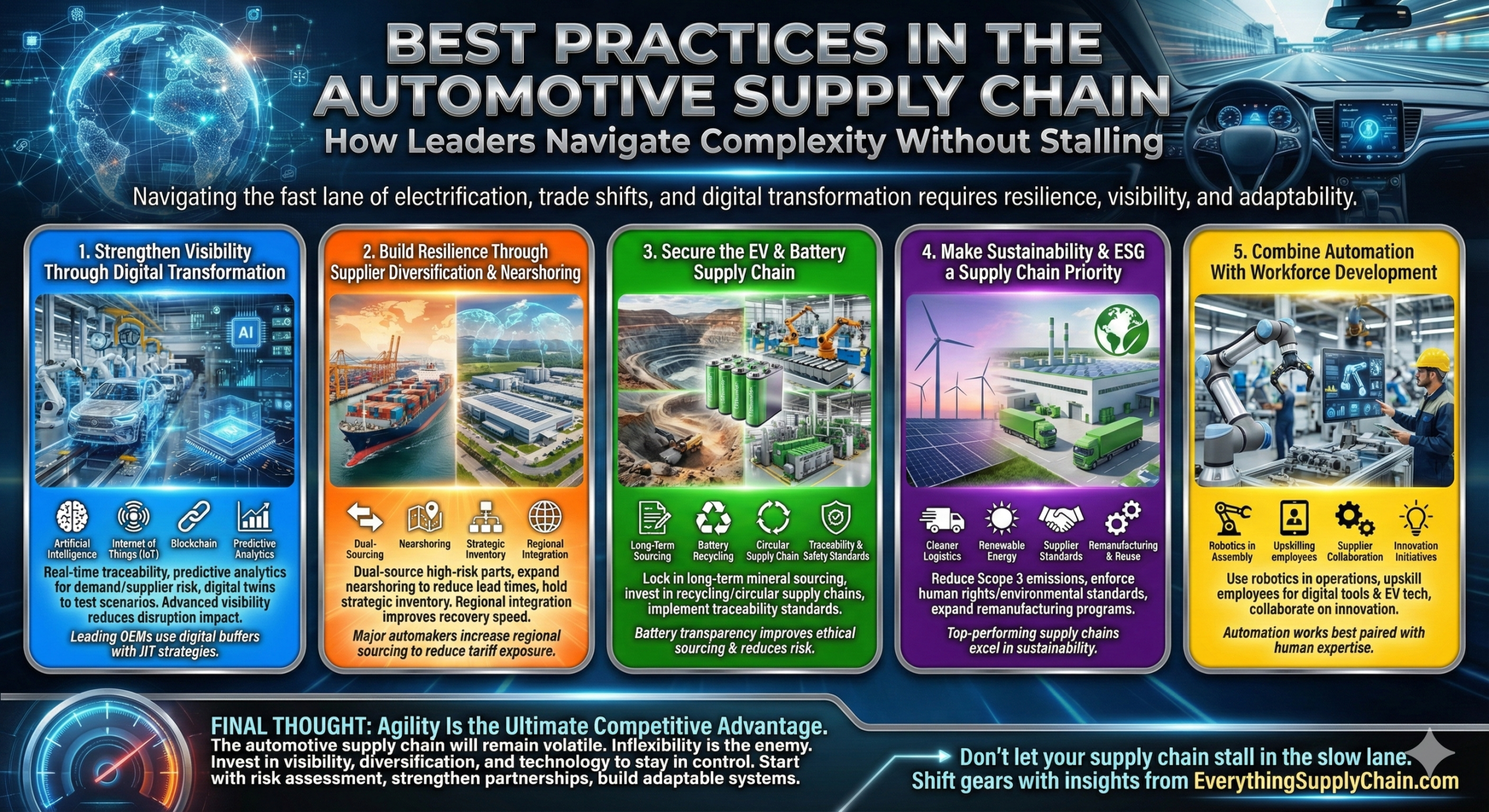
1. Strengthen Visibility Through Digital Transformation
Limited visibility beyond Tier 1 suppliers has been a major contributor to recent disruptions. When companies can’t see problems coming, they end up reacting instead of responding.
Best practices include:
- Deploying AI, IoT, and blockchain for end-to-end traceability
- Using predictive analytics to anticipate demand shifts and supplier risks
- Applying digital twins to test scenarios before disruptions hit
Organizations with advanced visibility tools consistently reduce the impact of disruptions—proving that what you can see, you can manage.
In practice: Leading OEMs such as Toyota continue refining just-in-time strategies by pairing them with digital buffers for greater flexibility.
2. Build Resilience Through Supplier Diversification and Nearshoring
Global supply chains are becoming more regional as tariffs, trade restrictions, and geopolitical uncertainty reshape sourcing strategies. Relying on a single supplier—or a single region—for critical components is no longer a calculated risk; it’s a gamble.
Best practices include:
- Dual-sourcing high-risk components like semiconductors
- Expanding nearshoring to reduce lead times and exposure
- Holding strategic inventory buffers for critical parts
Regional integration doesn’t eliminate risk—but it dramatically improves recovery speed.
Real-world approach: Major automakers have increased regional sourcing to reduce tariff exposure and improve responsiveness.
3. Secure the EV and Battery Supply Chain
The transition to electric vehicles has shifted supply chain risk upstream—straight into battery materials and critical minerals. Lithium, cobalt, and nickel volatility now directly impacts production stability.
Best practices include:
- Locking in long-term sourcing agreements for key minerals
- Investing in battery recycling and circular supply chains
- Implementing traceability and safety standards across battery handling
Battery transparency initiatives are gaining traction, helping companies improve ethical sourcing while reducing regulatory risk.
4. Make Sustainability and ESG a Supply Chain Priority
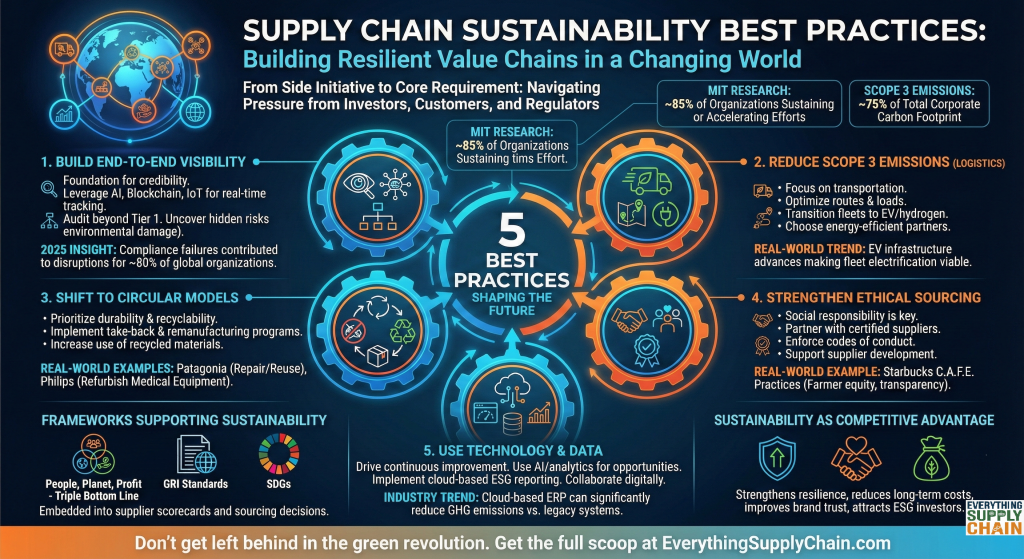
Automotive supply chains face growing pressure to decarbonize, improve labor practices, and increase transparency. Sustainability is no longer confined to corporate reporting—it’s embedded in supplier selection and operations.
Best practices include:
- Reducing Scope 3 emissions through cleaner logistics and renewable energy
- Enforcing supplier standards for human rights and environmental compliance
- Expanding remanufacturing, reuse, and recycling programs
Not surprisingly, top-performing supply chains tend to outperform on sustainability metrics as well.
5. Combine Automation With Workforce Development
Automation continues to expand across automotive manufacturing and logistics, driven by labor shortages and the need for precision and consistency.
Best practices include:
- Using robotics in assembly, inspection, and warehouse operations
- Upskilling employees for digital tools, automation, and EV technologies
- Collaborating with suppliers on shared innovation initiatives
Automation works best when paired with human expertise—not used as a replacement for it.
Industry reality: Automotive manufacturing now relies on a vast global robot workforce to maintain quality and efficiency at scale.
Final Thought: Agility Is the Ultimate Competitive Advantage
The automotive supply chain will remain volatile—but volatility isn’t the enemy. Inflexibility is.
Companies that invest in visibility, diversification, sustainability, and technology are better equipped to absorb shocks, meet regulatory demands, and deliver the vehicles customers expect—without unnecessary delays or cost overruns.
Start with a clear risk assessment, strengthen supplier partnerships, and build systems that adapt as quickly as the market changes.
Because in automotive supply chains, the goal isn’t just to keep moving—
it’s to stay in control while doing it.